


LURPA > Previous organization > Geo3D team
Performance assessment of non-contact digitizing systems
No standard exists to evaluate measurements obtained by non-contact measuring systems. We develop protocols to qualify non-contact measuring systems.
Quality indicators and assessment protocols
3D digitizing systems deliver a set of discrete data which must be an appropriate representation of the object's surface with respect to its use. For example, direct milling from discrete date requires that the point cloud be complete prior to the calculation of tool trajectories. We proposed to qualify the point cloud using quality and operational indicators. Quality indicators, the digitizing noise and the trueness account for the quality of the acquired data. These indicators are evaluated thanks to an experimental qualification protocol based on the measurement of simple geometrical artefacts (QUALIPSO). Operational indicators are generally associated to the acquisition performance, as for completeness, point density, measured area, or range angle).
This original protocol has been tested for various the camera-based systems (sensor/device) and on different sites. This has led to the development of a data base of qualified measurement systems to support the system selection for a given application.
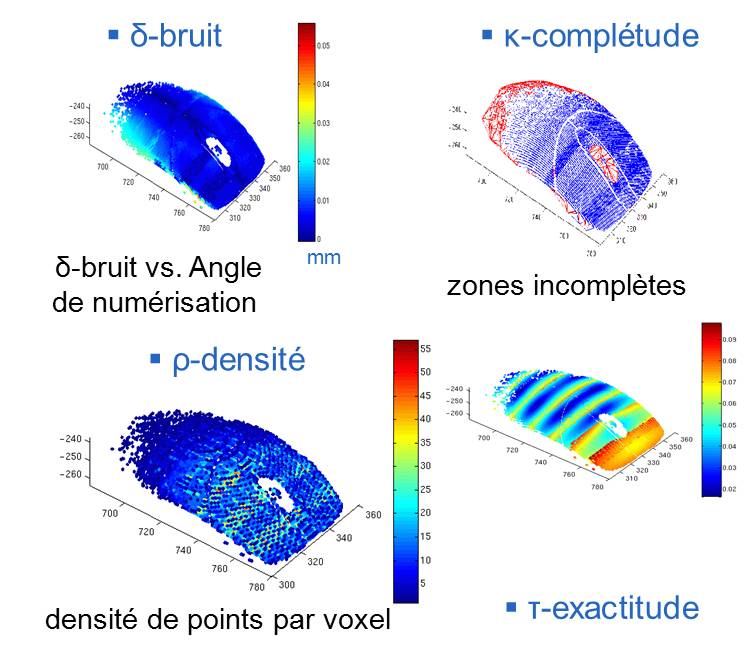
This original protocol has been tested for various the camera-based systems (sensor/device) and on different sites. This has led to the development of a data base of qualified measurement systems to support the system selection for a given application.
Calibration and uncertainties of 3D workspace
We develop method to calibrate 3D workspace associated to measuring systems. The aim is the determination of volumetric errors at each point of the 3D space.
First, a Monte-Carlo method for the propagation of uncertainties was implemented in order to calibrate the measurement space of a camera-based vision system. With such an approach it is possible to determine the optimal number of required cameras to reach an expected uncertainty (Airbus group).
An approach to determine volumetric errors of a 3D workspace based on multilateration using a unique laser tracer was developed. The method relies on the construction of a reference measuring system built from the laser tracer positions. Procedure limits are identified and to evaluate associated uncertainties associated a virtual measurement module was developed. Considering a working space with volumetric errors, the module simulates a realistic 3D calibration and allows the study of the influence of each uncertainty factor on the calibration procedure thanks to a Monte-Carlo approach (LNE).
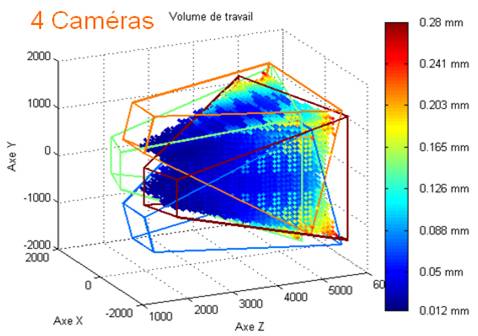
First, a Monte-Carlo method for the propagation of uncertainties was implemented in order to calibrate the measurement space of a camera-based vision system. With such an approach it is possible to determine the optimal number of required cameras to reach an expected uncertainty (Airbus group).
An approach to determine volumetric errors of a 3D workspace based on multilateration using a unique laser tracer was developed. The method relies on the construction of a reference measuring system built from the laser tracer positions. Procedure limits are identified and to evaluate associated uncertainties associated a virtual measurement module was developed. Considering a working space with volumetric errors, the module simulates a realistic 3D calibration and allows the study of the influence of each uncertainty factor on the calibration procedure thanks to a Monte-Carlo approach (LNE).
Équipe de rattachement
Publications
- Publications sur 5 ans (depuis 2008)
- Publications antérieures (jusqu'à 2007)